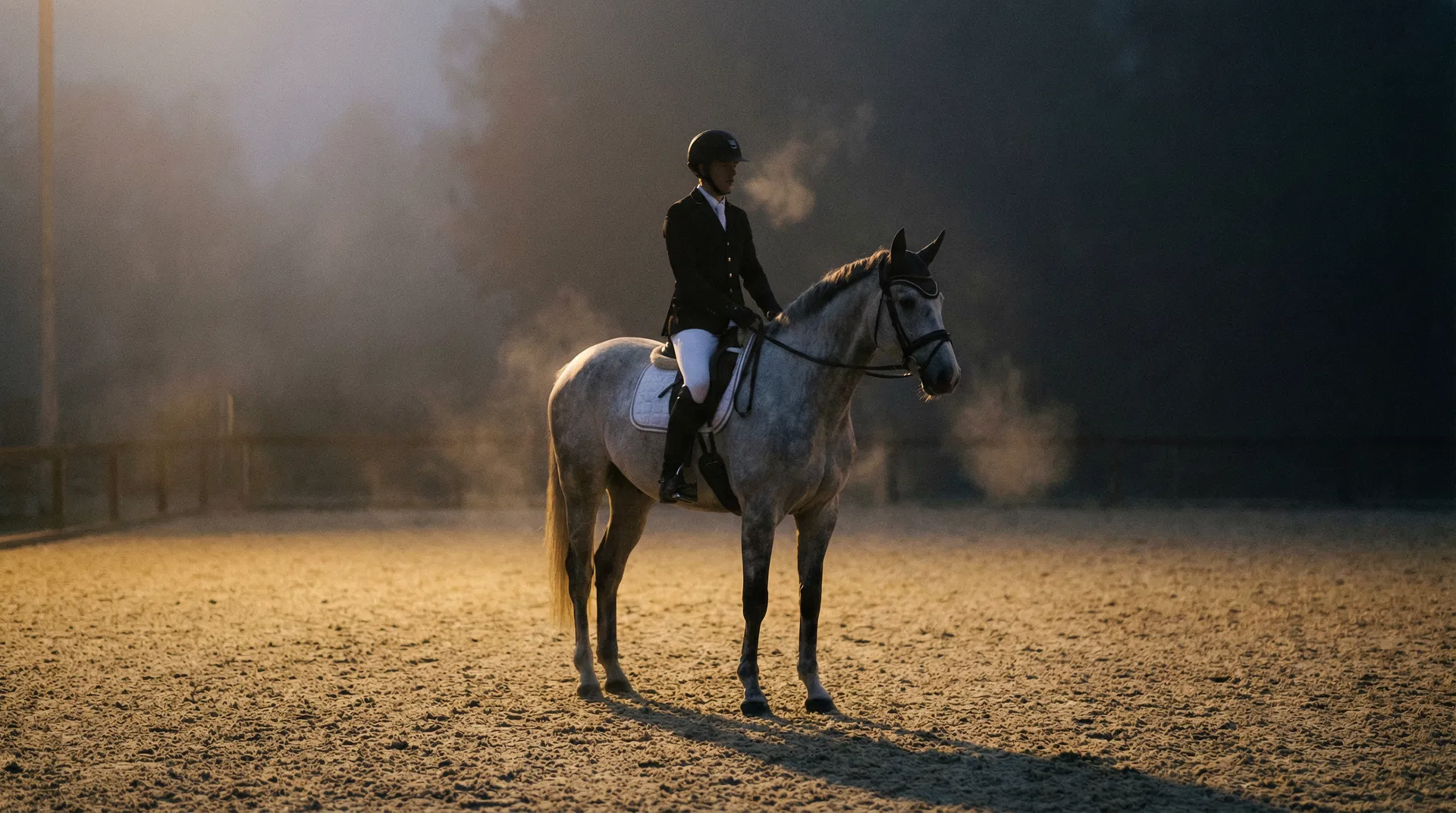
We live in a culture that rewards speed. Response time is treated as competence. Whoever answers first, delivers first, scales first — wins. But the most consequential decisions I have made in my life did not emerge in the fastest moment. They emerged in the pause before it.
The horse that waits for the right moment
In show jumping, there is a moment every rider knows and most fear: the moment before takeoff, when the horse does not yet know whether it will jump. It is a fraction of a second — but in that second, everything is decided. Taking off too early means knocking the fence. Too late means falling. The right moment lies exactly between the two, and it cannot be forced.
I have competed at international level for over twenty years. And the most important thing horses taught me is not courage. It is not technique. It is waiting for the right moment — and the ability to recognize that moment when it arrives. This sounds simple. It is the most difficult skill I know.
"The horse taught me that the right moment is never the first moment. It is the moment after you have learned to wait."
— Andy Candin
Patience is not passivity
The greatest misunderstanding about patience is that it means passivity. Waiting as the absence of action. Patience as weakness disguised as virtue. This misunderstanding is dangerous — because it leads people either to act too early, or not at all, because they cannot endure the tension of waiting.
Real patience is active. It is the ability to hold tension without resolving it prematurely. It requires attention, judgment, and the discipline to distinguish between the impulse to act and the right moment to act. A rider waiting for the takeoff is not passive — they are maximally present. Observing, adjusting, preparing. Just not yet acting.
Patience is not the absence of action. It is the ability to choose the moment of action — rather than being chosen by it.
What neuroscience tells us
Research on delayed gratification — made famous by the Stanford marshmallow experiments of the 1970s — shows that the ability to wait is one of the strongest predictors of long-term success. Children who were able to wait for a second reward achieved better academic results, more stable relationships, and higher professional success decades later.
What these studies measure is not willpower in the classical sense. It is the ability to strengthen the prefrontal cortex — the part of the brain responsible for long-term planning and impulse control — against the limbic system, which is oriented toward immediate reward. Patience is, neurologically speaking, the ability to represent the future in the present — and to act accordingly.
This ability is trainable. It is not a personality trait you either have or do not. It is a competence developed through practice — through repeated experiences in which you overcome the impulse to act immediately and observe the quality of the outcome that emerges from waiting.
Patience as competitive advantage in the age of AI
In a world where AI systems can respond in milliseconds, where automation reduces response time to zero, where every delay is treated as inefficiency — what is the value of human patience?
The answer is paradoxical: patience becomes more valuable, not less. Precisely because AI systems are fast, the human ability to pause, reflect, and choose the right moment becomes the decisive differentiator. The organizations that will fail in the age of AI are not those that respond too slowly. They are those that act too quickly — without checking the quality of their decisions.
"AI can decide faster than any human. But it cannot decide whether this moment is the right moment to decide."
— Andy Candin
In my work with European SMEs, I have repeatedly observed the same pattern: organizations introducing AI tools because market pressure seems to demand it, without checking whether the problem they want to solve is actually the problem that needs solving. They act quickly. They act wrongly. And the correction costs three times what waiting would have cost.
The EU AI Act and institutional patience
It is no coincidence that the EU AI Act — the world's first comprehensive AI regulatory framework — is designed around slowing down. Not stopping, but deliberate deceleration: risk classification, conformity assessment, transparency requirements, human oversight. All of this costs time. All of it is patience, institutionalized.
The criticism is familiar: Europe is falling behind the US and China. Regulation is slowing innovation. Bureaucracy is killing competition. This criticism is not entirely wrong — but it misses something decisive: the organizations that will earn the trust of their customers, partners, and regulators in the age of AI are not the fastest. They are the most reliable.
Trust is the result of patience. It does not emerge from speed — it emerges from consistency over time.
The EU AI Act forces organizations to ask questions they would not ask without regulatory pressure: Who is responsible for this system? What risks arise for whom? How is the decision documented and made verifiable? These questions are uncomfortable. They slow things down. But they produce a quality of decision that fast systems cannot replicate.
Patience in leadership: when to wait and when to act
The most difficult question in practice is not whether to be patient. It is: when is patience strategic — and when is it avoidance? When is waiting for the right moment wisdom — and when is it fear of acting?
I have no universal answer to this question. But I have developed a heuristic that helps me in most situations: patience is strategic when it is accompanied by preparation. When the waiting is used to understand more, observe more, develop more options — then it is patience. When the waiting is used to avoid the decision, to defer responsibility, to escape clarity — then it is hesitation.
The rider waiting for the takeoff is prepared. They have studied the fence. They know their horse. They know what they will do when the moment comes. The waiting is not passive — it is the final phase of preparation. And when the moment arrives, they act without hesitation.
"Preparation without patience leads to mistakes. Patience without preparation leads to missed moments. Both together lead to excellence."
— Andy Candin
What patience means in practice
Patience is not an abstract virtue. It has concrete manifestations in daily work. In the context of AI governance, it means: do not deploy AI systems before the question of accountability is resolved. In the context of leadership, it means: do not make decisions before the relevant information is available — even when the pressure to decide is intense. In the context of relationships, it means: do not force trust, but build it through consistent action over time.
In my own work, I have learned that the moments when I was under the most pressure to act quickly were often the moments when waiting produced the highest return. Not because waiting is always right — but because pressure is a poor advisor. Pressure generates reaction. Patience generates decision.
This is the difference I try to anchor in every system I build: not the ability to respond quickly — but the ability to choose the moment when the response will have the greatest impact. That is not a question of technology. It is a question of human maturity.
"The most important decisions of my life were not made in the fastest moments. They were made in the moments when I had learned to wait."
— Andy Candin